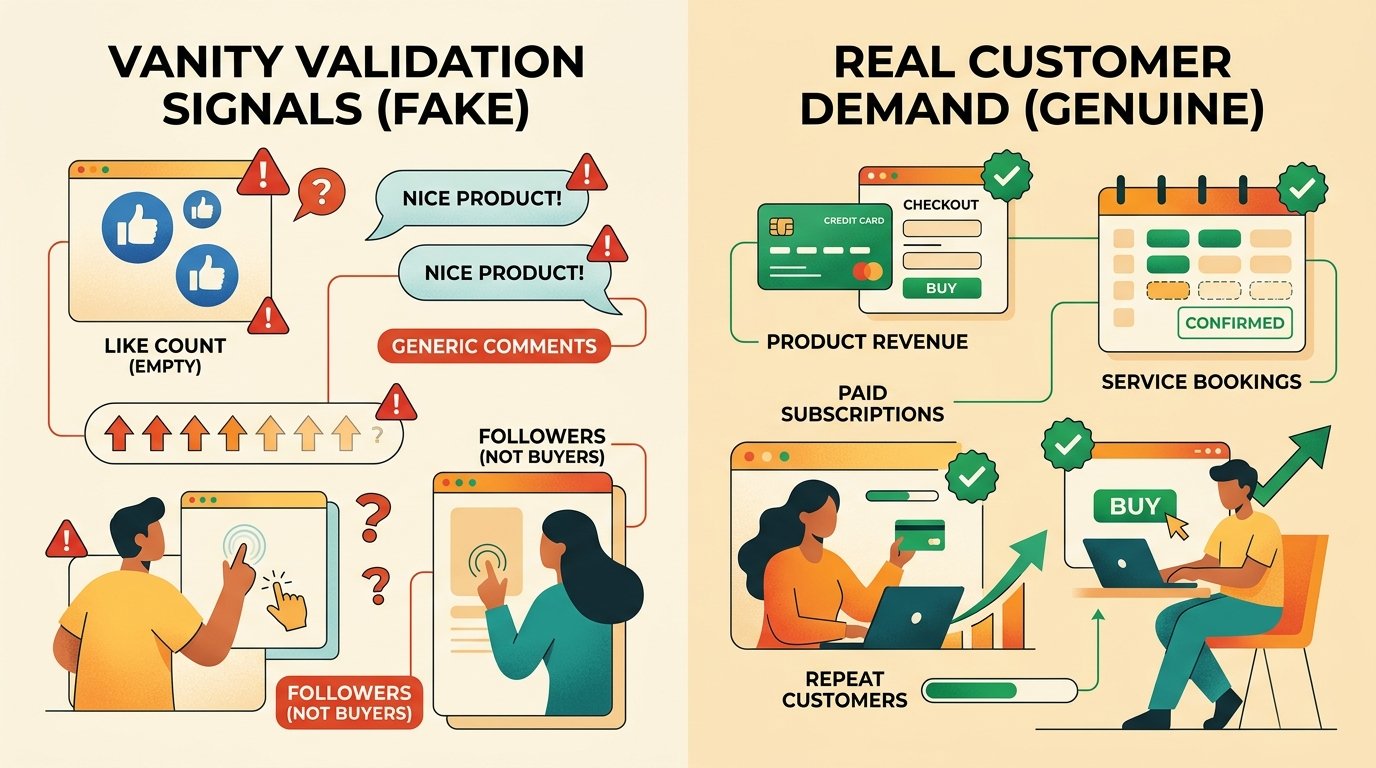
"That sounds like an amazing idea! You should totally build that."
Ask any failed startup founder what their early validation looked like, and they will tell you a nearly identical story: Everyone they spoke to loved the concept. Their LinkedIn post got 40 likes. Over 150 people signed up for their landing page waitlist.
Yet, three months after launch day, zero people pulled out a credit card.
Why does this happen so frequently? Because human beings are conditioned to be polite, and modern internet platforms are designed to generate low-effort vanity validation. Here are the 7 fake signals that trick founders into building products nobody actually buys—and what real buyer commitment looks like instead.
Fake Signal #1: Polite Praise From Peers and Friends
Your friends, colleagues, and parents want you to be happy. If you describe an idea to them, they will instinctively look for reasons to validate your creativity.
The Rule of Reality: Unless someone has actively tried to solve this exact problem with their own time or money in the past 30 days, their opinion on your idea has zero statistical value.
Fake Signal #2: Product Hunt and Twitter Upvotes
A post going viral on X (Twitter) or reaching the top 5 on Product Hunt creates an artificial dopamine rush. But Product Hunt audiences are predominantly other builders browsing shiny tools during lunch.
Upvotes indicate entertainment value or aesthetic appreciation, not commercial intent. An indie hacker upvoting your slick dashboard UI is not a B2B procurement manager willing to sign an annual contract.
Fake Signal #3: "Keep Me Updated" Waitlist Emails
Submitting an email address into a generic hero form takes approximately 4 seconds and costs the visitor nothing. It is a zero-cost social courtesy.
Industry benchmarks show that traditional "sign up for early access" email waitlists routinely convert to paying customers at under 2.5%. If you have 500 emails on an untargeted waitlist, you likely have fewer than 10 actual customers.
Fake Signal #4: Free Beta Users Who Never Log Back In
When you offer a SaaS tool for free during beta, you attract bargain hunters, hobbyists, and digital tourists.
A user who logs in once, clicks three buttons, and never returns has not validated your product—they have tested your onboarding and found it lacking. Track Day 7 and Day 30 active retention, not raw registration counts.
Fake Signal #5: "I'd Buy This If It Had [Feature X]"
This is the classic deflection tactic during customer interviews. When someone says, "I'd definitely buy this if it integrated with HubSpot and had automated PDF reporting," founders make the mistake of rushing to build those features.
When you return six weeks later with Feature X built, that same prospect will say: "Awesome! Now we just need Salesforce support and SSO." Prospective buyers who truly feel the pain will buy your ugly v1 without Feature X.
Fake Signal #6: High Website Traffic With Low Dwell Time
Getting 10,000 visitors from Hacker News or a Reddit thread means you wrote an engaging headline. If those visitors bounce after 12 seconds without clicking your pricing table, reading your FAQ, or engaging with your interactive validation widget, your bounce rate proves lack of buyer relevance.
Fake Signal #7: Enthusiastic Survey Responses
Surveys are notorious for collecting aspirational answers. If you ask people: "Would you pay $20/month for an app that saves you 2 hours every week on invoice reconciliation?" 90% will click Yes.
Why? Because answering Yes costs nothing and aligns with how they wish they behaved. But when the invoice arrives, their budget priorities speak otherwise.
What Does Genuine Validation Look Like?
Genuine validation always requires sacrifice. Prospective customers must give up something scarce before code is written:
THE COMMITMENT HIERARCHY
▲
│ [ Tier 4 ] Financial Commitment: Pre-order deposit ($10–$99) or signed LOI
│ [ Tier 3 ] Time Sacrifice: 30-minute deep discovery call or workflow audit
│ [ Tier 2 ] Reputation Risk: Introducing you to their team lead or decision-maker
│ [ Tier 1 ] High-Friction Data: Sharing sensitive workflow files, logs, or spreadsheets
▼
If a prospect is unwilling to give you 20 minutes on Zoom, introduce you to their department manager, or put down a $10 refundable pilot deposit, they will not pay $50/month for your software once it launches.
Test for skin in the game early. It hurts to hear a "No" in week one, but it is infinitely better than discovering silence after six months of solitary development.