The biggest pitfall in early-stage software development isn't bad code or slow servers—it is building something nobody actually needs.
Customer discovery is supposed to protect founders from this exact fate. Yet, the majority of founder discovery interviews are fundamentally flawed. Entrepreneurs schedule calls, show wireframes, and ask leading questions like:
- "Do you think our AI document organizer would make your workday easier?"
- "Would you find a unified project dashboard useful?"
These questions are useless. They invite generic flattery and theoretical agreement.
To uncover whether people will actually pay for your SaaS, you need a disciplined discovery framework that interrogates past behavior instead of soliciting future promises.
The 3 Cardinal Rules of Customer Discovery
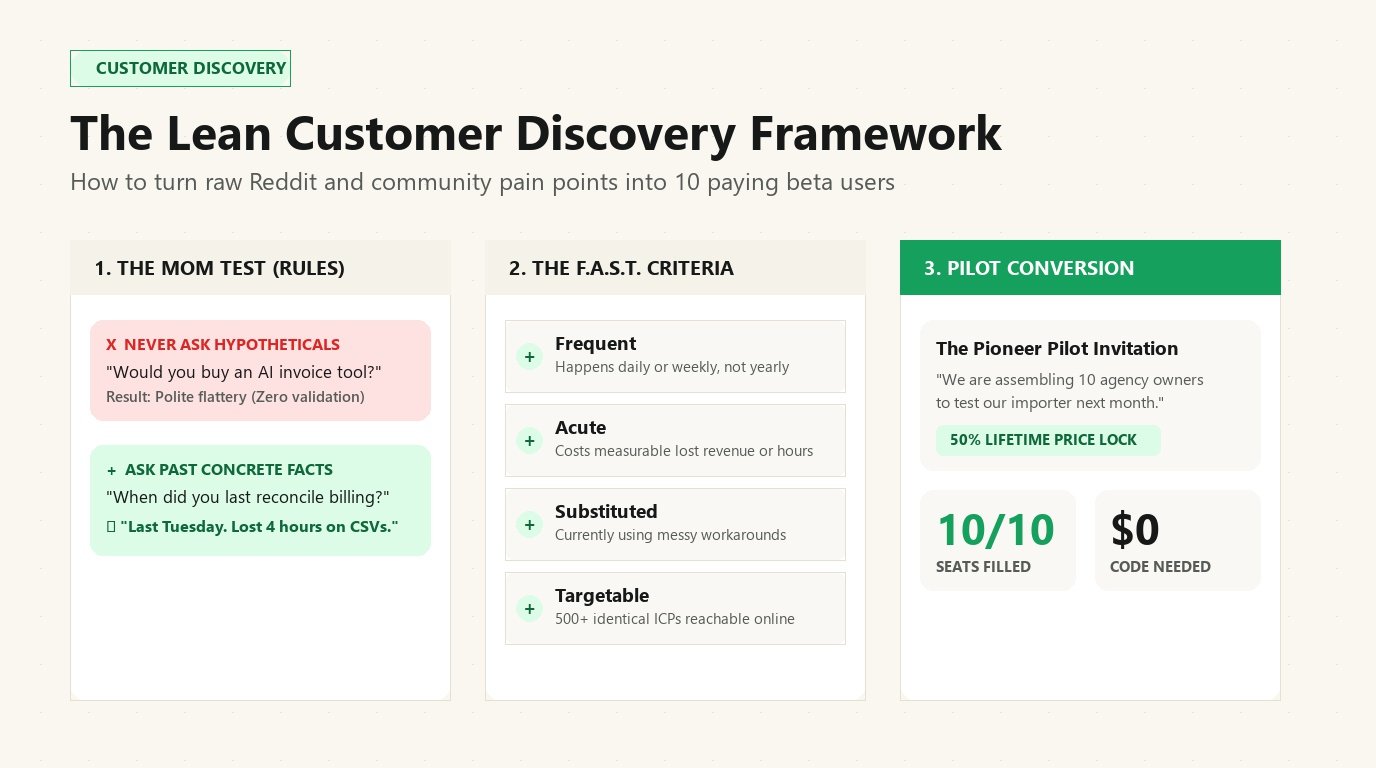
Inspired by Rob Fitzpatrick's seminal book The Mom Test, every discovery call should adhere to three foundational constraints:
Rule 1: Never Mention Your Solution or Product Idea
The moment you describe your product, the interview transforms from an objective behavioral autopsy into a sales pitch. Keep your proposed solution hidden until the very final 3 minutes of the conversation.
Rule 2: Anchor Every Question in Past, Concrete History
Do not ask people what they plan to do or what they might buy. Ask about the last time they encountered the problem:
- "When was the last time you ran into this bottleneck?"
- "Walk me through your exact screen workflow when that happened on Tuesday."
- "What specific workaround did you use to finish the task?"
Rule 3: Dig Into the Emotional and Financial Impact
If a problem only mildly annoys someone for 30 seconds once a quarter, they will never allocate budget for it. You must unearth the stakes:
- "What happened as a result of that file getting lost?"
- "Did that delay impact client deadlines or team billing?"
- "Did you have to assign a junior team member to manually reconcile that data?"
The 20-Minute Discovery Interview Script
Here is a structured, four-phase question architecture designed for 20-minute Zoom conversations:
[ Phase 1: Context & Role ] (3 mins)
  ↳ "Walk me through what your typical Tuesday looks like when handling [Workflow]."

[ Phase 2: The Last Occurrence ] (7 mins)
  ↳ "Can you walk me through the last time you had to deal with [Specific Problem]?"
  ↳ "What made that instance particularly frustrating or time-consuming?"

[ Phase 3: The Current Workaround & Budget ] (7 mins)
  ↳ "What tools or manual steps did you piece together to solve it?"
  ↳ "What do those software licenses or manual labor hours currently cost your team?"
  ↳ "What other dedicated solutions have you researched and discarded?"

[ Phase 4: The Commitment Threshold ] (3 mins)
  ↳ "If we build a focused tool that automates [Specific Step], would you want to join our private pilot cohort next month?"
The High-Value Problem Checklist
Before you declare a problem "validated" and begin sprinting in your code editor, verify that your findings satisfy the F.A.S.T. Criteria:
| Dimension | The Validation Test |
| :--- | :--- |
| Frequent | Does the problem occur daily or weekly rather than once per year? |
| Acute | Does the issue cost measurable revenue, lead to client churn, or waste significant labor hours? |
| Substituted | Are they already spending money or engineering time on clumsy workarounds (spreadsheets, Zapier, manual contractors)? |
| Targetable | Can you easily identify and message 500 identical job titles on LinkedIn, Reddit, or industry communities? |
If your problem checks all four boxes, you have struck gold.
Transitioning From Discovery to Paying Beta Users
The beauty of running proper customer discovery interviews is that your interviewees naturally become your first paying customers.
At the conclusion of the interview, don't say goodbye empty-handed. Close with a specific, low-risk invitation:
*"This has been incredibly enlightening, Sarah. Based on what you shared about the 4 hours your team loses every week to manual CSV imports, we are actually assembling an early pilot group of 10 agency owners next month to test our automated importer.
We're offering our pilot members lifetime 50% pricing and direct weekly input on the feature roadmap. Can I put your name down for one of those 10 seats?"*
When someone has spent 18 minutes detailing how much pain a problem causes them, accepting your invitation to solve it is the natural next step.