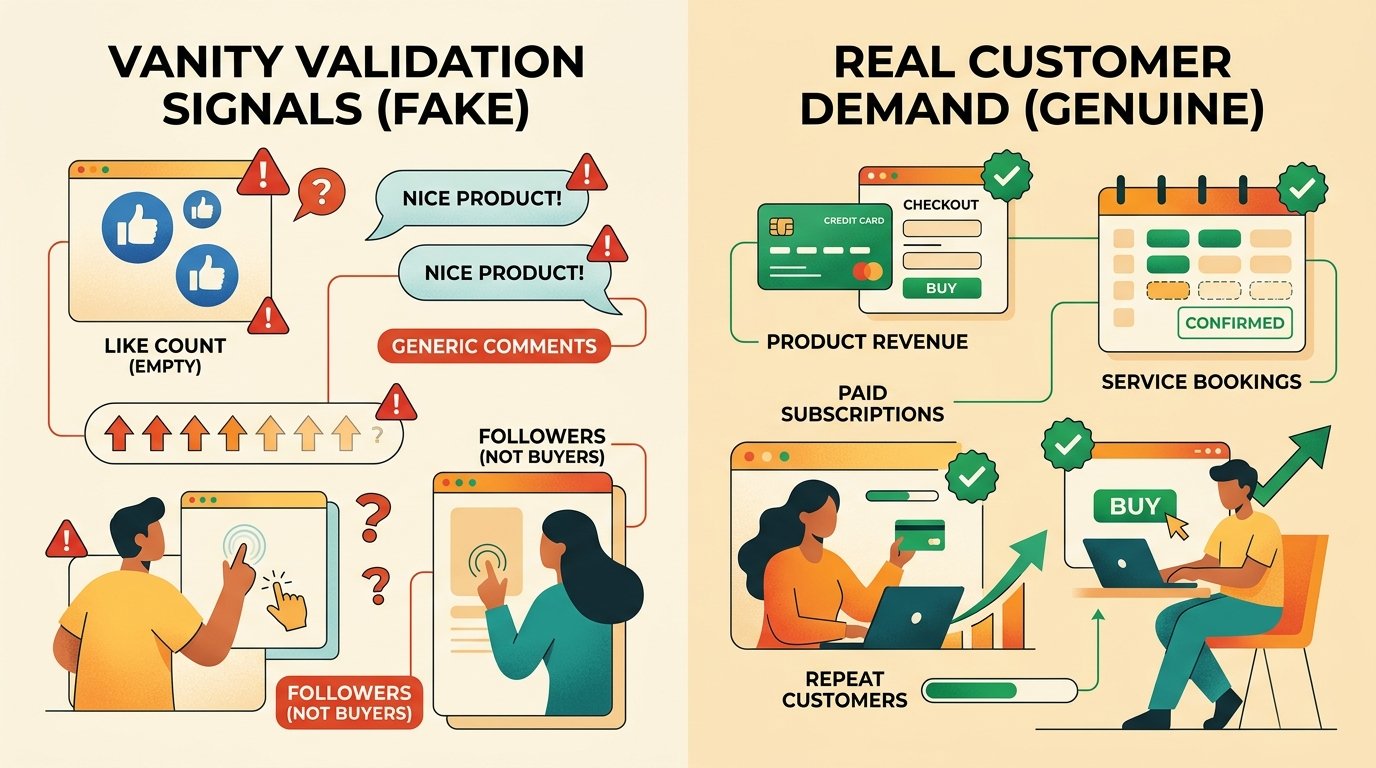
Email-only waitlists are the single most dangerous vanity metric in software development. Collecting 500 email signups on a free landing page creates a false sense of security that almost always evaporates into zero paying customers upon launch.
To build a sustainable SaaS business, founders must replace passive email capture with verified willingness-to-pay testing.
1. Why Do Traditional Waitlist Landing Pages Fail?
Traditional waitlists fail because submitting an email address carries zero economic friction, resulting in a 95% drop-off when an actual paywall is introduced. An email indicates mild curiosity, never a commitment to purchase software.
Founders celebrate reaching 1,000 waitlist subscribers, build the product for six months, send the launch announcement, and watch only 3 people convert. The reason is simple: People value free things until you ask them to pay for them.
2. The Difference Between Interest and Willingness to Pay
Interest is a casual curiosity that costs the visitor nothing, whereas willingness to pay is an active decision to exchange capital for time savings or revenue generation. True customer validation only occurs when economic friction is introduced into the testing process.
| Metric Type | Example Action | Commercial Validity | Predictive Reliability |
| :--- | :--- | :--- | :--- |
| Vanity Signal | Entering an email for early access | Very Low | < 5% Paid Conversion |
| Social Signal | Retweeting a mockup or liking on LinkedIn | Low | < 2% Paid Conversion |
| Intent Signal | Selecting a specific price tier ($49/mo) | High | 25–40% Paid Conversion |
| Committed Signal | Google-verified identity + price selection | Very High | 45–65% Paid Conversion |
3. How Nexify Measures Real Commercial Demand
Nexify measures genuine willingness to pay by requiring landing page visitors to evaluate concrete pricing tiers and authenticate their response using verified Google identity. This eliminates tire-kickers and accurately benchmarks price elasticity before engineering begins.
Instead of a generic "Join 500+ founders on the waitlist" input box, Nexify validation pages:
- Present Clear Pricing Tiers: Visitors must choose between transparent price points (e.g., $19/mo, $49/mo, or "I wouldn't pay").
- Track Disqualification Reasons: Visitors who select "I wouldn't pay" are asked why, providing immediate feedback on feature gaps or pricing misalignment.
- Prevent Duplicate Manipulation: Identity verification prevents bots and spam accounts from artificially skewing your demand score.
- Instant Founder Telegram Alerts: Every time a visitor confirms they would pay for your upcoming SaaS, you receive an instant alert on your phone.
4. The 3 Questions That Predict SaaS Survival
To determine if a software product will survive commercial launch, founders must answer three objective questions:
- Is the problem acute enough that users are already spending money on broken workarounds?
- Will visitors willingly select a paid tier before seeing the software?
- Do at least 15–20% of unique landing page visitors complete verification with commercial intent?
If your Nexify validation score achieves 15%+ verified willing-to-pay conversion, you have mathematically de-risked your MVP launch.
5. Conclusion: Validate Dollars, Not Inbox Addresses
Stop building for imaginary users who gave you an email address they never check. Build for buyers who explicitly stated what they would pay to make their problem disappear.