Ask a question that is hard to answer politely.
A validation page puts a concrete price next to your idea and forces the visitor to choose. That single change transforms “looks cool” into a number you can count — and “no thanks” into the most useful data you will collect all month.

One page. One uncomfortable question.
The page is generated once from your research evidence, with any field overridable at the moment it is created. It lives at its own short URL and stays public for as long as you need it.
Visitors are not asked to “sign up for updates”. They are asked what they would pay — and one of the options is always that they wouldn’t. Removing the polite escape is the entire point: without it, you are collecting encouragement, not validation evidence.
Two limitations worth stating up front: a page is generated once and cannot be edited afterwards, and there is no delete control in the dashboard yet. Changing the copy means generating a new page.
Where the page fits in the workflowWhy the “wouldn’t pay” option matters
When you remove every polite escape from a form, the responses that remain carry real weight. A person who types their email and picks “$49/mo” is doing something their friend who said “great idea!” was not: they are making a choice under mild friction.
That is not proof they will buy. But it is a stronger signal than anything you will collect with a vague interest form.
A response and a verified response are not the same thing.
We keep them separate on purpose. Anything that inflates the number is bad evidence — even when it feels good.
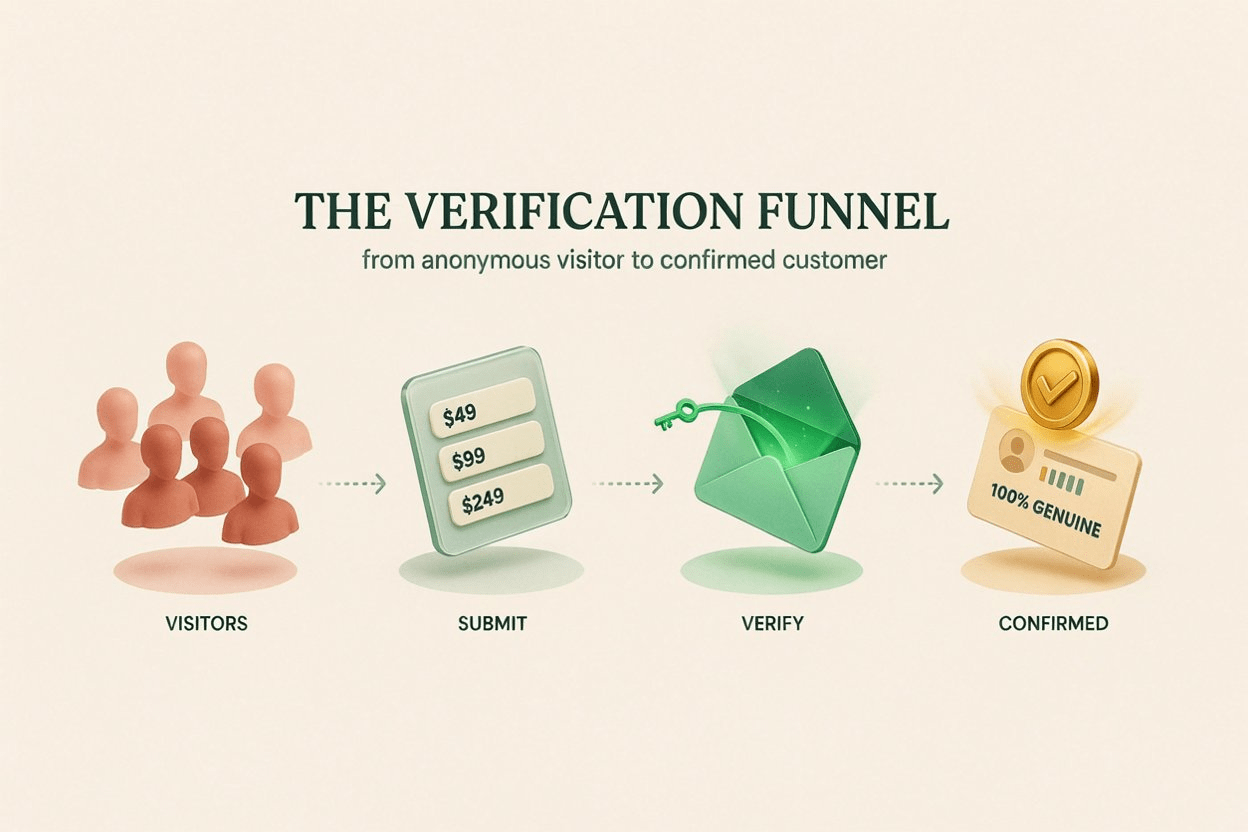
Why the split matters
Ten responses with one verified address is weaker evidence than three responses with three verified addresses. Nexify shows both numbers side by side so you can see the gap instead of guessing at it. The gap is the signal.
What the page holds.
Every field below is generated once, from your evidence. Any of them can be overridden at generation time if you would rather write the copy yourself.
| Title | The headline a visitor reads first. |
| Short description | One or two sentences of context under the title. |
| Problem | The problem you found in the evidence, in plain language. |
| Solution | What you propose to do about it. |
| Benefits | A short list, generated from the evidence. |
| Call to action | The button label, e.g. “Request access”. |
| Pricing question | The question the price options answer. |
| Pricing options | Concrete choices, including a “wouldn’t pay” option. |
| Status | Published, paused, or archived. |
| Selected price | Which option they picked, or that they wouldn’t pay. |
| Would pay | Derived from the choice. Never inferred from a page view. |
| Email address | Required, and the target of the verification link. |
| Reason | Optional free text — usually the most useful thing on the page. |
| Attribution | Tracking link, ref code and any UTM parameters present. |
| Visitor hash | A salted hash used to group views. The raw IP is not stored. |
See the privacy policy for how long this is kept and who can see it.
Enough to act on. Nothing more.
There is no hidden profile building behind the form — the fields in the table are the whole record. The raw IP address is never stored. The visitor is identified only by a salted hash that cannot be reversed.
Read the privacy policyPrecise language, so nobody oversells the result.
The biggest risk in early validation is confusing enthusiasm with intent. We use specific terms deliberately — to keep the dashboard honest and to stop founders from reading signals that aren’t there.
“Response” — not lead, not customer.
Somebody submitted the form. They have not agreed to buy anything, and no money has moved. It is a data point, not a sale.
“Verified response” — a reachable address.
The confirmation link was clicked. That is all it proves: the email exists and the person who submitted it controls it. That is still meaningfully more than an unverified response.
“Stated willingness to pay” — not revenue.
What people say they would pay is a signal about interest. It is not a forecast, a commitment, or a promise. People are consistently more generous with hypothetical money than with real money.
“Demand signal” — not a verdict.
Evidence plus responses tells you where to look next. It does not tell you that your idea is guaranteed to work — that determination requires customers paying real money for a real product.